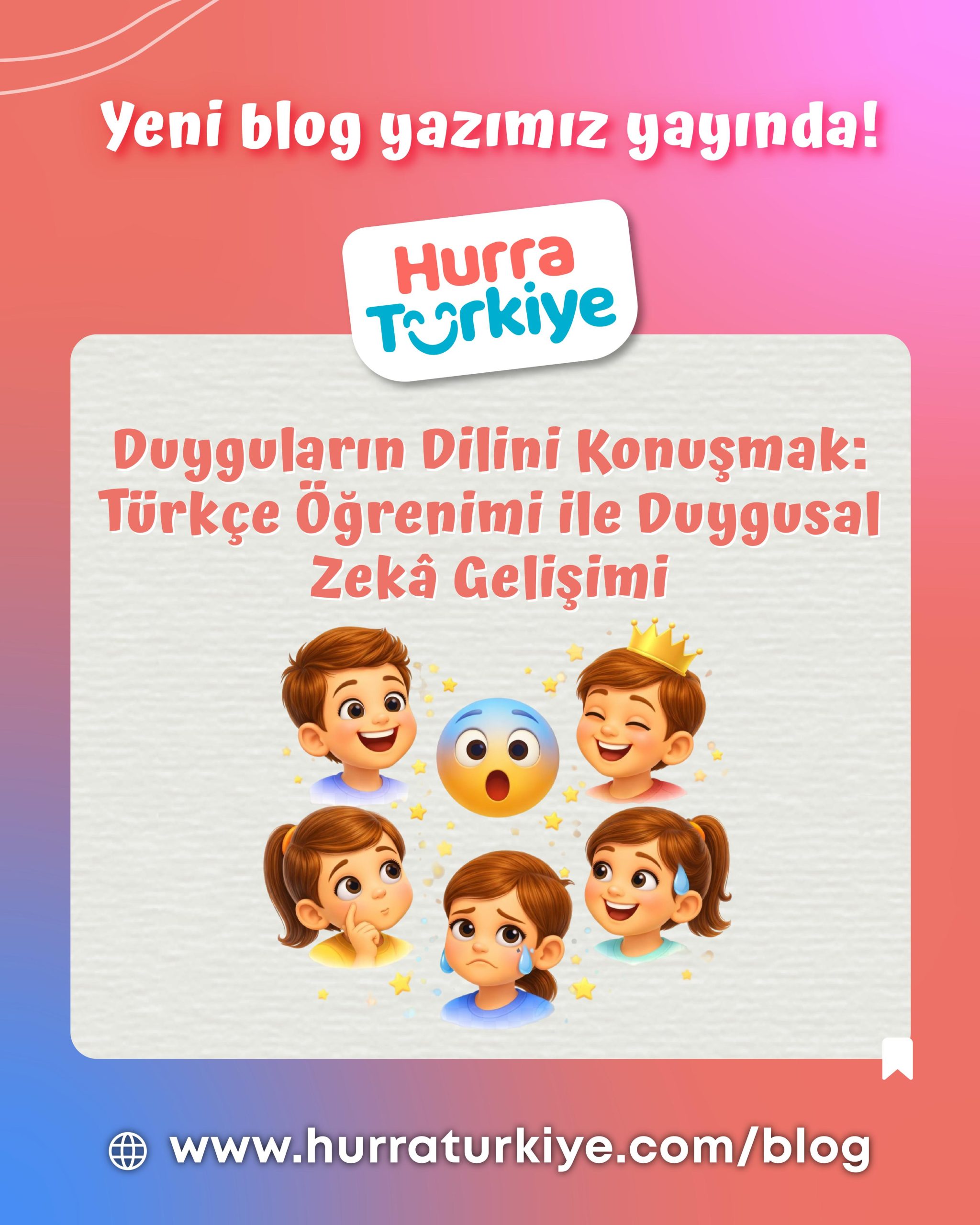
Children don't just learn words; He also learns to express his emotions.
Sentences like "I'm happy", "I'm hurt", "I'm scared"; It forms the basis for the child to know his inner world and establish healthy relationships with his environment.
Learning Turkish is one of the most natural tools that strengthens this emotional expression. When a child can express his feelings in his native language, he feels safer, realizes that he is understandable, and gains the courage to communicate.
In this article; Together, we discuss how learning Turkish contributes to children's emotional intelligence development and how you can support this process in daily life.
Why Do Children Need to Express Their Emotions?
Emotions become understandable as they are named.
When children can express the emotion they feel with the right words, it becomes much easier for them to understand and manage that emotion. Expressions such as "I'm sorry", "I'm angry", "I'm scared" clarify the child's inner world and help him recognize his emotions. As emotions are put into words, confusion diminishes; The child realizes more easily what he feels.
A child who can express himself feels safer
The child who sees that he can express his feelings feels understood. This feeling is one of the cornerstones of self-confidence. A child who knows that he can express himself establishes a healthier relationship with both himself and his environment. Thus, language is not only a means of communicating; It also becomes a powerful tool for the child to feel safe.
How Does Turkish Language Development Support Emotional Intelligence?
Turkish offers a wide scope to express emotions
Turkish has a very rich vocabulary to describe emotions. This diversity of expression helps the child express his feelings more accurately, clearly and in more detail. A child who can put into words what he feels learns to recognize and manage his emotions. This supports the development of self-awareness and emotional balance skills.
Daily conversations strengthen empathy
Daily conversations in Turkish enable the child to notice not only his own feelings but also the feelings of others. Thanks to small moments shared, simple questions asked and mutual conversations, the child becomes more open to understanding the other person and approaching his/her feelings with empathy. Thus, Turkish is not just a means of communication; It becomes a bridge that nourishes the child's emotional world and strengthens his relationships.
Why is it important to connect with emotions when learning Turkish?
Language is not just about words; It's a way to connect
Children don't use language just to memorize words. Language is also a tool through which they express their emotions, explain themselves and connect with their environment. A word that accompanies an emotion becomes much more meaningful for the child. This meaning strengthens learning.
Words learned with emotions are more permanent
Learning a word alone can be challenging. However, when that word accompanies an emotion, a moment or an experience, it gains a much stronger place in the mind. The child not only remembers that word; Uses it over and over again with the feeling of it.
That's why learning Turkish becomes permanent when supported by emotions.
Language ceases to be memorized information; It becomes a natural form of expression that settles into the child's life.
How Can Parents Support This Process at Home?
Include emotion words in daily conversations
During the day, “What made you happy today?”, “Are you sad about anything?” Asking simple questions, such as, can help you understand your child's feelings. to express in Turkish It opens a natural area for These short but regular conversations strengthen both language skills and emotional awareness together.
Make emotions visible with stories and games
Read Turkish stories together, play small games or role-plays about emotions. For example, talking about what a character in a story is feeling or asking your child to act out his or her own “feeling story” makes it easier for them to recognize emotions and put them into words.
Thanks to these little moments, Turkish is not just a language learned for your child;
It becomes a safe space where they can express their emotions easily.
Learning Turkish with Emotions in Hurra Türkiye
Turkish lessons at Hurra Türkiye are where children can express themselves comfortably. safe and supportive progresses in an environment. In these lessons, not only words are taught; Children express their feelings, thoughts and situations they encounter in daily life. Opportunity to explain in Turkish finds it. Thus, language learning; It turns into a real experience that is nourished not by memorized sentences, but by expressions coming from the child's inner world.
Learning Turkish not only improves children's language skills; It also strengthens their self-confidence, their ability to express their emotions and their ability to empathize. Children who grow up in an environment where they can put their feelings into words develop both Turkish and their own inner world more firmly, more consciously and with more ownership.
? Do you want your child to express his/her feelings easily while learning Turkish?
Hurrah is in Turkey Try your first lesson for free, let's start this journey together.


 Free trial lesson